
A Presented Stem contains more information than a Candidate should repeat. The task during the Stem-Review Phase is to identify what changes management, rank those facts, build a primary plan, and prepare to revise that plan when the Examiner adds information.
A useful review produces six things:
- A one-sentence representation of the clinical situation.
- A short, ranked list of patient and procedural priorities.
- A primary anesthetic plan with case-specific reasons.
- Conditional alternatives and contingency plans.
- A concise first spoken answer.
- A structure that can be updated during the Full-Length Oral Exam.
Practical heuristic: Move through four stages:
Raw fact → implication → plan consequence → spoken answer
If a fact does not affect a decision, priority, sequence, resource, goal, contingency, or disposition, it usually does not need prominent space in the outline.
The outline described here is a cognitive aid for practice. It is not a script, an official form, a scoring rubric, or a universal clinical template.
How to read the evidence labels
Claims in this guide are marked by their status:
- Official exam fact: Information established by an official ABA source.
- Evidence-supported learning method: A method supported by peer-reviewed learning or simulation research.
- Defensible educational extrapolation: A reasoned application of broader evidence to SOE preparation that has not been directly tested for the ABA SOE.
- Practical heuristic: A useful rule of thumb that is neither official nor proven to be optimal.
- Unknown or undisclosed: Information that should not be inferred, including exact scoring rules, passing thresholds, Examiner intent, and the meaning of an interruption.
What the Presented Stem review is for
Official exam fact: The SOE takes one hour and forty minutes and includes two 35-minute examination sessions. The first Presented Stem review is 20 minutes, and the second is 10 minutes. The SOE assesses judgment, adaptability to unexpected clinical changes, and the organization and presentation of information. It also emphasizes the scientific rationale underlying clinical management decisions. See the ABA APPLIED Exam manual.
Official exam fact: The official sample SOE questions commonly ask for a decision, rationale, interpretation, alternative, or response to changed information.
The official sample demonstrates forms of questioning. It is not a complete content outline, a prediction of future questions, or an official model-answer template.
Unknown or undisclosed: This guide does not infer scoring rules, passing thresholds, Examiner intent, or what an interruption or change of topic means. Candidates should use the current ABA APPLIED Exam resources for current rules and logistics.
The purpose of the Stem-Review Phase is therefore not to produce the longest possible set of notes. It is to enter the Full-Length Oral Exam with an organized hierarchy:
- What is happening?
- What matters most?
- What will I do?
- Why is that appropriate for this Presented Stem?
- What would make me change?
- What remains uncertain?
The stem-to-speech workflow
1. Build a one-sentence situation representation
The first task is not to copy the history. It is to determine what kind of situation the Candidate is entering.
Practical heuristic: Complete this sentence mentally:
“This is a patient with [dominant patient problem or physiologic state] undergoing [procedure and urgency], with the plan constrained by [one or two decisive factors].”
A useful representation includes:
- The procedure and urgency.
- The patient’s trajectory, such as stable, deteriorating, incompletely evaluated, or recovering.
- The dominant physiologic or safety threat.
- One or two constraints that change technique, sequence, resources, or disposition.
It should not contain every diagnosis, value, or routine perioperative task. It is an attention-setting tool, not a memorized opening statement.
2. Identify discriminating facts
A discriminating fact changes a decision, priority, sequence, resource, goal, contingency, or postoperative plan.
Practical heuristic: the counterfactual test
Ask of each fact:
“If this fact were absent, normal, or reversed, would I choose or sequence anything differently?”
If the answer is no, the fact may remain available in the Presented Stem without being copied into the outline.
A fact is more likely to be discriminating if it changes:
- Whether or when the case proceeds.
- The immediate safety threat.
- The primary technique.
- Airway or induction planning.
- Monitoring, access, blood preparation, or specialized equipment.
- A physiologic goal.
- The likelihood or consequence of a complication.
- Emergence criteria or postoperative destination.
Do not confuse unusual with important. A rare diagnosis may matter less than a common but currently unstable physiologic problem.
3. Rank rather than transcribe
Practical heuristic: Rank selected facts in three levels:
- Current, time-sensitive threat: What could harm the patient now or during the next transition?
- Plan constraint: What changes technique, induction, monitoring, maintenance, emergence, or disposition?
- Anticipated contingency: What is not occurring now but is plausible enough to prepare for?
The printable worksheet has eight numbered problem rows. A Candidate does not need to fill all eight. Empty space is preferable to low-value transcription.
Avoid:
- Rewriting the Presented Stem in shorter sentences.
- Giving every comorbidity equal weight.
- Preserving the order in which facts appeared.
- Listing a diagnosis without its consequence.
- Treating every abnormal value as equally important.
4. Separate current findings from contingencies
A possible future complication is not automatically a current diagnosis.
Practical heuristic: Mark notes as:
- NOW: Established by the Presented Stem.
- IF: A contingency that would change management if it occurred.
For example:
| NOW | IF |
|---|---|
| Current hypotension | Possible major blood loss |
| Known difficult airway | Failure of the first airway approach |
| Current ventilatory insufficiency | Risk of postoperative ventilatory insufficiency |
This distinction allows the Candidate to be prepared without overstating what is known.
5. Convert facts into implications and actions
Use this chain:
Raw fact → clinical implication → management consequence
Before:
“Cardiomyopathy.”
After:
“Limited cardiovascular reserve may reduce tolerance of abrupt loading changes, so induction, monitoring, fluid management, and disposition require case-specific adjustment.”
The second version makes the reasoning visible. It also tells the Candidate where the fact belongs in the plan.
A factor may have a preoperative implication but no distinctive postoperative consequence, or the reverse. Blank cells are acceptable when no material connection exists.
6. Make a primary decision
A Candidate should choose a primary approach before listing alternatives.
Practical heuristic:
- Decision: “I would…”
- Reason: “because…”
- Condition or contingency: “If…, I would instead…”
- Stop.
Not every question requires every element. A narrow question may need only the decision and one reason. A broad question may require a contingency or disposition. Exact wording should not be memorized.
Before:
“I could use general anesthesia, regional anesthesia, or a combined technique depending on the situation.”
After:
“I would use the primary technique because it addresses these two case-specific constraints. If the stated condition were not met, I would use the alternative.”
The improved answer makes both commitment and adaptability visible.
7. Use alternatives conditionally
An alternative becomes useful when the Candidate can name the condition that activates it.
“My primary plan is A. If specific finding, contraindication, or failure condition occurs, I would move to B because reason.”
Avoid menu answers that name several technically possible options without ranking them. A Plan B or Plan C should respond to a defined failure or changed condition, not merely list another device or technique.
8. Put the requested decision first
Official exam fact: The ABA identifies organization, presentation, judgment, and scientific rationale among the abilities assessed in the SOE. See the ABA APPLIED Exam manual.
Practical heuristic: Put the requested decision in the first sentence. Give one or two case-linked reasons. Add a condition only if it clarifies adaptation. Then pause.
For a broad request to describe the anesthetic plan, the opening may include:
- Primary technique or immediate decision.
- The two most consequential risks.
- Preparation that directly addresses those risks.
- Emergence or disposition if it is case-defining.
For a narrow question about one test, monitor, or event, answer that question. Do not recite the entire anesthetic plan.
For task-specific response examples and a stopping checklist, use the guide to what a strong ABA SOE answer should sound like.
9. Stop before over-answering
Completeness and exhaustiveness are different.
- Completeness: Enough information to make the decision and reasoning understandable.
- Exhaustiveness: Everything the Candidate knows about the topic.
Practical heuristic: After the decision, relevant rationale, and necessary condition, pause. The Examiner can ask for more.
A useful self-check is:
“Have I answered the question asked, or have I moved into the next three questions?”
10. Update the plan explicitly
Official exam fact: Adaptability to unexpected clinical changes is among the abilities identified in the ABA APPLIED Exam manual.
When new information changes an assumption, the Candidate should not continue defending the original plan.
Practical heuristic:
- Acknowledge the change: “That new information changes…”
- Identify what is no longer valid.
- State the revised decision.
- Explain the new priority.
- Preserve any part of the original plan that remains appropriate.
Changing a plan is not inherently evidence that the first plan was wrong. A conditional plan should change when its conditions change.
How to identify and rank important facts
The central transformation is not from “long Presented Stem” to “short Presented Stem.” It is from data to decisions.
| Stage | Question | Output |
|---|---|---|
| Raw fact | What does the Presented Stem establish? | “Persistent hypotension after initial treatment” |
| Implication | Why does it matter in this case? | “Limited tolerance of induction and concern about perfusion” |
| Plan consequence | What changes because of it? | “Preparation, access, monitoring, induction, and disposition” |
| Spoken answer | What should the Examiner hear first? | “I would treat induction as a high-risk hemodynamic transition…” |
Not every important fact belongs in the first answer. Some facts:
- Determine the opening decision.
- Support the rationale.
- Guide a contingency.
- Remain available for follow-up.
- Become relevant only after the Examiner changes the situation.
A useful outline therefore has hierarchy, not just content.
How to build and defend a plan
A complete practice outline should answer five questions:
- Primary decision: What will I do?
- Case-linked rationale: Which Presented Stem facts support it?
- Main limitation or tradeoff: What concern remains?
- Conditional alternative: What finding or failure would make me change?
- Transition and disposition: What must be true for emergence, extubation, or the planned destination?
Defensible educational extrapolation: A short outline may reduce avoidable search and organization demands while supporting development of usable knowledge structures. This application is consistent with cognitive load theory in medical education, but this worksheet has not been validated for the ABA SOE. The goal is not less thinking. It is to direct attention toward consequential reasoning.
Field-by-field worksheet guidance
The fields below are optional prompts. They are not official ABA categories and should not be treated as a required examination-day structure.
Patient factors and problems
- Purpose: Convert medical history into a ranked problem representation.
- Ask: “Which current findings alter risk, sequence, technique, goals, or disposition?”
- Include: Active disease, instability, trajectory, relevant medications, functional limitation, and plan-changing studies.
- Exclude: Duplicate facts, routine demographics, and stable history with no case implication.
- First answer: Use the top one or two problems as reasons for the initial decision.
- Failure and drill: Do not list diagnoses without severity or consequence. In 60 seconds, reduce ten patient facts to three and state why each survived.
Case and procedural factors
- Purpose: Identify how the procedure constrains the anesthetic.
- Ask: “What changes because of urgency, positioning, access, physiologic stress, expected loss, equipment, or postoperative needs?”
- Include: Procedure, urgency, relevant duration, position, location, access limitations, anticipated disturbance, and material pain or blood-loss considerations.
- Exclude: Generic operating-room tasks and exhaustive surgical descriptions.
- First answer: Name a procedural factor when it drives technique, preparation, or disposition.
- Failure and drill: Do not overlook the procedure while cataloging comorbidities. Apply the same fictional patient to two procedures and identify three plan changes.
Preoperative management and workup
- Purpose: Identify what must be clarified, optimized, coordinated, or prepared before the next step.
- Ask: “What information or action could materially change whether, when, or how I proceed?”
- Include: Focused examination, review or follow-up of relevant studies, coordination, optimization, consent issues, and decisive preparation.
- Exclude: Reflexive lists of tests, consultations, or ideal elective optimization.
- First answer: Mention only prerequisites or immediate safety measures.
- Failure and drill: Account for urgency and the cost of delay. From five possible actions, keep the two most likely to change the plan.
Intraoperative management
- Purpose: Connect each major problem to recognition and management during induction, maintenance, and surgical transitions.
- Ask: “How might this factor appear, and what would prompt a change?”
- Include: Problem-specific monitoring, likely manifestations, management priorities, transition risks, and contingency triggers.
- Exclude: A duplicate anesthetic blueprint or list of remote complications.
- First answer: Include the intraoperative priority that best explains the primary plan.
- Failure and drill: Replace “monitor closely” with a 20-second chain: “I am watching for X, I would recognize it by Y, and if it occurs I would change Z.”
Postoperative management
- Purpose: Extend reasoning beyond the end of surgery.
- Ask: “What risk persists or emerges, and what monitoring or destination does it require?”
- Include: Residual physiologic concerns, pain and respiratory risk, surveillance, continuing treatment, destination, and escalation criteria.
- Exclude: Generic recovery checklists and unsupported assumptions that all high-risk patients need the same destination.
- First answer: Include disposition when it follows directly from instability or technique.
- Failure and drill: For three Presented Stems, state a destination and one finding that would change it.
Technique, rationale, backup, and regional role
- Purpose: Require a primary choice while preserving adaptability.
- Ask: “What is my preferred technique, why does it fit, and what would make me change?”
- Include: One primary technique, one or two case-specific reasons, a backup trigger, and a relevant regional role.
- Exclude: Unranked menus and generic technique comparisons.
- First answer: When asked for an anesthetic plan, the primary technique usually belongs in the first clause.
- Failure and drill: Choose within 20 seconds. Change one Presented Stem fact and decide whether the choice, backup, or rationale changes.
Monitors, access, equipment, and blood
- Purpose: Translate anticipated physiology and procedure demands into resources.
- Ask: “What is needed beyond ordinary preparation to detect or manage the most consequential problems?”
- Include: Case-specific monitoring, access, rescue equipment, blood preparation, and escalation triggers.
- Exclude: Operating-room inventories, unexplained invasive procedures, and arbitrary numbers of lines or units.
- First answer: Mention only resources central to safe execution of the plan.
- Failure and drill: For every resource, complete: “I need this because it will let me detect, measure, or treat ___.”
Airway and induction
- Purpose: Prepare for a high-risk transition.
- Ask: “What are the airway, aspiration, oxygenation, ventilation, and hemodynamic risks during induction?”
- Include: Relevant findings, primary and rescue approaches, sequence, help, equipment, and physiologic goals.
- Exclude: Drug doses, detached algorithms, and device lists without failure conditions.
- First answer: Lead with airway or induction when it is the dominant immediate threat.
- Failure and drill: Give a 30-second brief containing the main risk, Plan A, the trigger for Plan B, and the physiologic priority.
Physiologic goals
- Purpose: Convert disease labels into variables to preserve, avoid, or correct.
- Ask: “Which changes would this patient tolerate poorly, and how will I recognize them?”
- Include: Case-linked goals for perfusion, pressure, rhythm, oxygenation, ventilation, temperature, and volume status.
- Exclude: Unsupported numerical thresholds, generic goals, and conflicting targets.
- First answer: State only the one or two goals that explain the plan.
- Failure and drill: Replace “maintain stability” with one goal, the harm it prevents, the observation used to track it, and the trigger for changing the plan.
Case-specific unsafe actions or thresholds
- Purpose: Define boundaries that could make a superficially reasonable plan unsafe.
- Ask: “What action, omission, assumption, or threshold would be particularly hazardous?”
- Include: A small number of case-specific no-go conditions, harmful delays, or reassessment triggers.
- Exclude: Universal slogans, trivia, remote complications, and casual use of “never event.”
- First answer: Mention a boundary only when central to the immediate decision.
- Failure and drill: Invert the plan by asking, “What would make this unsafe?” Write no more than three answers.
Maintenance
- Purpose: Organize how the initial plan will be sustained and adjusted.
- Ask: “How will I manage anesthesia, ventilation, hemodynamics, losses, analgesia, temperature, nausea risk, and positioning in this case?”
- Include: A coherent approach and the highest-priority case-linked goals.
- Exclude: Medication shopping lists, routine details with no case connection, and unsupported fixed fluid or transfusion rules.
- First answer: Summarize major goals unless the Examiner asks for one component.
- Failure and drill: Give a 45-second maintenance plan, then repeat it in 20 seconds without losing the top three priorities.
Emergence and disposition
- Purpose: Make emergence a deliberate decision with criteria, alternatives, and a destination.
- Ask: “Should the patient be extubated or remain ventilated, what findings govern that choice, and where should the patient go?”
- Include: Emergence risks, criteria, destination, monitoring, and immediate postoperative priorities.
- Exclude: “Extubate awake” or “ICU” without case-specific reasoning.
- First answer: State likely disposition early when it follows from current instability or residual risk.
- Failure and drill: Practice: “My default is ___; if the patient demonstrates ___, I would instead ___.” Change the end-of-case facts and repeat.
How the 20-minute and 10-minute reviews differ
Official exam fact: The first Presented Stem review is 20 minutes, and the second is 10 minutes. See the ABA APPLIED Exam manual.
Defensible educational extrapolation: The same reasoning architecture can be used in both reviews. The shorter review should operate at lower resolution rather than attempt to reproduce the longer review twice as fast.
| Review task | First 20-minute review | Second 10-minute review |
|---|---|---|
| Situation | Minutes 0 to 3: procedure, urgency, trajectory, dominant threat | Minutes 0 to 2: procedure, urgency, trajectory, dominant threat |
| Priorities | Minutes 3 to 8: rank patient and procedural factors | Minutes 2 to 5: select three discriminating facts |
| Implications | Minutes 8 to 14: connect high-priority factors across perioperative phases | Integrated into the selected facts at lower detail |
| Plan | Minutes 14 to 18: primary technique, resources, goals, backups, emergence | Minutes 5 to 8: primary technique, immediate preparation, one contingency, disposition |
| Rehearsal | Minutes 18 to 20: speak the opening and locate notes | Minutes 8 to 10: speak the opening and locate supporting details |
| Intended output | Broad but ranked perioperative map | Minimum viable plan |
These allocations are practical heuristics, not ABA instructions.
For the 10-minute review, a minimum viable plan is:
- Three ranked factors.
- One primary technique.
- One immediate transition risk.
- One conditional backup.
- One emergence or disposition decision.
Do not judge the 10-minute outline by how closely it resembles the 20-minute outline.
Worked fictional example
Fictional and illustrative: This Presented Stem is original. It is not a retired, remembered, reconstructed, or claimed representative ABA question.
Educational boundary: This example demonstrates reasoning structure. It is not patient-specific guidance, a model ABA answer, or a claim that one approach is universally correct. It should receive named anesthesiologist review before publication.
Fictional Presented Stem
A 68-year-old woman presents for urgent exploratory laparotomy for suspected perforated bowel. She has had abdominal pain, distention, and repeated vomiting for approximately one day. Imaging shows free intraperitoneal air, and the surgeon anticipates a contaminated field with possible bowel resection.
Her heart rate is 118 beats per minute, blood pressure is 92/54 mm Hg after initial treatment, temperature is 38.4°C, and oxygen saturation is 93% while receiving supplemental oxygen. A nasogastric tube continues to drain gastric contents. Laboratory results include hemoglobin 9.3 g/dL, creatinine 2.0 mg/dL from a documented baseline of 1.0 mg/dL, and lactate 4.1 mmol/L.
Her history includes ischemic cardiomyopathy with a previously documented left ventricular ejection fraction of 35%, chronic obstructive pulmonary disease without home oxygen use, and gastroesophageal reflux. She has two peripheral intravenous catheters, but one is functioning poorly. Blood has been requested but has not yet arrived.
Initial question: “Describe your anesthetic plan and immediate priorities.”
One-sentence representation
This is a patient with impaired perfusion and limited cardiopulmonary reserve undergoing urgent laparotomy, with the plan constrained by ongoing aspiration risk and a potentially unstable induction.
Fact-to-plan transformation
| Raw fact | Implication | Plan consequence |
|---|---|---|
| Urgent laparotomy for suspected perforation | Time-sensitive procedure with potential deterioration | Continue response-guided resuscitation, verify timely antimicrobial therapy, and expedite surgical source control in parallel |
| Repeated vomiting and continued gastric drainage | Ongoing aspiration concern | Plan a secured airway, suction, and airway rescue preparation |
| Hypotension, tachycardia, elevated lactate, acute creatinine increase | Current perfusion concern | Improve access, prepare support, and closely assess the induction transition |
| Cardiomyopathy with reduced ejection fraction | Limited cardiovascular reserve | Tailor induction, fluid, and hemodynamic management to response |
| Pulmonary disease and oxygen requirement | Increased respiratory concern | Use end-of-case gas exchange and physiology to guide emergence |
| Anemia, possible resection, blood not yet available | Potential blood-loss and oxygen-delivery concern | Confirm readiness and communication before major loss |
| One unreliable intravenous catheter | Current access may be inadequate | Establish reliable access and a credible escalation plan |
Not every important fact belongs in the opening answer. Some facts support the plan and remain available for follow-up.
Condensed problem matrix
| Priority | Preoperative implication | Intraoperative implication | Postoperative implication |
|---|---|---|---|
| Current perfusion concern | Reassess response, establish access, coordinate urgent preparation | Closely assess pressure, perfusion, losses, and response | Continue monitoring and support in an appropriate setting |
| Ongoing aspiration concern | Continue decompression strategy and prepare suction and rescue resources | Use a secured airway and aspiration-conscious approach | Base extubation on airway protection and overall physiology |
| Limited cardiopulmonary reserve | Clarify relevant baseline information without avoidable delay | Avoid abrupt, poorly tolerated physiologic changes | Monitor for residual cardiovascular and respiratory dysfunction |
| Urgent contaminated laparotomy | Verify timely antimicrobial therapy and prepare in parallel for source control | Reassess as surgical findings and losses evolve | Continue surveillance for organ dysfunction and complications |
| Possible blood loss with anemia | Confirm testing, availability, and communication | Assess losses and physiologic consequences | Reassess bleeding, anemia, and perfusion |
Illustrative anesthetic blueprint
- Primary technique: General anesthesia with tracheal intubation.
- Rationale: The operation requires laparotomy, with ongoing aspiration and physiologic concerns.
- Backup: Define airway and oxygenation rescue plans before induction. Worsening instability would activate additional support, personnel, or a revised sequence.
- Regional role: Any analgesic role would depend on hemodynamic status, coagulation considerations, infection context, and overall risk.
- Resources: Ensure reliable access, prepare suction and airway rescue equipment, connect additional monitoring to a defined need, and confirm blood-bank readiness appropriate to current physiology and anticipated loss.
- Induction: Treat aspiration and hemodynamic deterioration as simultaneous risks. Avoid a fixed drug or dose algorithm detached from the Presented Stem.
- Physiologic priorities: Preserve organ perfusion and avoid poorly tolerated changes in pressure, rhythm, oxygenation, or ventilation.
- Maintenance: Reassess ventilation, perfusion, losses, temperature, analgesia, and operative developments throughout the case.
- Unsafe assumptions: Do not treat this as a stable elective induction, assume gastric drainage removes aspiration risk, rely on inadequate access without escalation, or commit to extubation solely because surgery has ended.
- Emergence and disposition: Base ventilation, extubation, and destination on end-of-case physiology, organ dysfunction, support requirements, and continuing risk.
Illustrative first answer
“I would use general anesthesia with tracheal intubation for this urgent laparotomy and treat induction as a high-risk transition because she has ongoing aspiration risk and evidence of impaired perfusion. In parallel, I would continue response-guided resuscitation, verify appropriate empiric antimicrobial therapy, and expedite surgical source control. Before induction, I would ensure reliable access and have suction, airway rescue, and hemodynamic support immediately available, with blood-bank readiness matched to her physiology and anticipated loss. I would manage maintenance around perfusion, gas exchange, temperature, and evolving blood loss, and I would plan higher-acuity postoperative care, with extubation dependent on her end-of-case respiratory and hemodynamic status.”
Then stop.
Why the structure works:
- The primary decision appears first.
- The reasons come from the Presented Stem.
- Preparation is tied to the dominant risks.
- Maintenance is summarized rather than narrated.
- Disposition is conditional.
- Lower-priority details remain available for follow-up.
This is an illustrative first answer, not a model ABA answer.
Adaptation after new information
New fictional information:
At the end of surgery, the patient is awake and following commands, normothermic, hemodynamically stable without ongoing pharmacologic support, has acceptable gas exchange on modest respiratory support, and has no evidence of continuing bleeding.
Revised answer:
“Those findings now support considering awake extubation rather than continued ventilation, which had remained a contingency. I would first confirm sustained airway protection, adequate ventilation and oxygenation, acceptable respiratory mechanics, suitable pain control, and continued hemodynamic stability. Her initial perfusion abnormality, acute kidney injury, cardiomyopathy, and urgent intra-abdominal process would still support a closely monitored postoperative destination.”
The teaching point is not that extubation is always correct under these facts. The Candidate:
- Acknowledges the change.
- Identifies the assumption that no longer holds.
- Revises the decision.
- Preserves the remaining concerns.
- Does not maintain the original plan merely for consistency.
Practice protocol
1. Review under the appropriate clock
Choose a 20-minute or 10-minute Stem-Review Phase. Begin with a blank outline rather than a completed model.
Practice the two review periods separately. Compression is a distinct skill.
2. Speak from retrieval
Evidence-supported learning method: Effortful recall, spacing, and corrective feedback can improve retention in medical education. See test-enhanced learning in medical education and the systematic review of distributed and retrieval practice in health-professions education.
Defensible educational extrapolation: Speak from a short outline rather than reading a prepared answer. This practices retrieval in a format closer to the required oral performance, but it has not been shown to improve ABA SOE outcomes specifically.
If it is unclear whether the limiting problem is recall, spoken organization, adaptation, or access to feedback, use the SOE practice bottleneck sorter before choosing the next drill.
Record four responses:
- The first answer.
- A response to one request for rationale.
- One conditional alternative.
- One response to changed information.
3. Debrief the actual words used
Use a recording or transcript when possible. Examine whether:
- The decision appeared in the first sentence.
- The rationale used Presented Stem facts.
- Priorities were ranked.
- Alternatives had activation conditions.
- Current facts and contingencies remained distinct.
- The Candidate stopped after answering.
- New information produced an explicit update.
- Any statement was clinically inaccurate, unsafe, or more certain than the information allowed.
The ABA mock SOE faculty-development workshop provides professional-education context for structured mock practice. It is not an official Candidate scoring rubric.
The independent mock-oral debrief card provides a more detailed method for matching each feedback claim to an appropriate observer and testing one correction.
4. Perform a rapid retry
Evidence-supported learning method: Rapid-cycle deliberate-practice literature associates repeated performance with directed feedback with improvement in immediate performance. Long-term transfer and superiority over other simulation approaches remain uncertain. See the rapid-cycle deliberate-practice scoping review.
Defensible educational extrapolation: Retry the same oral question immediately after feedback, correcting one target:
- Move the decision to sentence one.
- Delete an irrelevant preamble.
- Replace a menu with one primary choice.
- Add the condition that activates the backup.
- State explicitly how a new fact changes the plan.
- Stop earlier.
Do not repeat the entire Presented Stem unless the outline itself was the primary problem.
5. Repeat after a delay
Evidence-supported learning method: Distributed retrieval often benefits retention, although health-professions studies are heterogeneous and do not establish one optimal schedule.
Practical heuristic: Retry the Presented Stem after several days using a blank worksheet, then revisit it later among different Presented Stems. Intervals such as two or three days and approximately one week are examples, not universal prescriptions.
The delayed attempt tests whether the Candidate learned a reasoning process rather than memorized a corrected sentence.
6. Use a goal, practice, observe, adjust cycle
Evidence-supported learning method: Self-regulated learning can be framed as setting a goal, practicing, observing performance, and adjusting. See the systematic review of self-regulated learning in clinical contexts.
Self-assessment alone should not be assumed accurate. When available, external feedback should verify:
- Clinical accuracy and safety.
- Whether the rationale supports the decision.
- Whether an omitted fact was important.
- Whether the Candidate adapted appropriately.
Use one primary correction per rapid retry. A long list of corrections can recreate the organizational burden the outline is intended to manage.
Independent progress measures
These are practice measures, not an ABA scoring system, readiness assessment, pass predictor, or claim about Examiner behavior.
Track:
- Decision stated in the first sentence: yes or no.
- Time from question to decision.
- Number of genuinely discriminating facts identified.
- NOW and IF separated: yes or no.
- Rationale linked to the Presented Stem: yes or no.
- Primary plan distinguishable from alternatives: yes or no.
- Alternative accompanied by a trigger: yes or no.
- Candidate stopped after answering: yes or no.
- Changed information produced an explicit update: yes or no.
- Number and type of clinical corrections required.
- Whether the same error recurred on delayed retrieval.
Progress means clearer prioritization, fewer repeated errors, more concise answers, and more appropriate adaptation. It does not require an arbitrary number of mock examinations.
When the question is whether the next attempt should be a Question Drill, Short Oral Exam, or Full-Length Oral Exam, use the mock-practice unit decision map.
Common failure modes
| Failure mode | Why it fails | Corrective drill |
|---|---|---|
| Copying the Presented Stem | Preserves data without creating priorities | Reduce ten facts to three plan-changing facts |
| Filling every box | Rewards completeness over discrimination | Leave a field blank unless it changes a decision |
| Giving a menu of techniques | Hides judgment | Choose one primary plan and one conditional backup |
| Naming diagnoses without implications | Does not connect knowledge to action | Complete: “This matters because…, so I would…” |
| Treating contingencies as facts | Overstates the current situation | Label notes NOW or IF |
| Scripting full answers | Increases rigidity and search time | Write cue words, then speak naturally |
| Giving rationale before the decision | Makes the answer harder to follow | Begin with “I would…” |
| Continuing after answering | Uses time and creates avoidable error exposure | Decision, concise reason, condition if needed, pause |
| Refusing to revise the plan | Does not respond to changed conditions | Say: “That changes my plan because…” |
| Repeating without feedback | Reinforces the same performance | Identify one target, retry, and revisit later |
| Practicing only long reviews | Does not train compression | Alternate 20-minute and 10-minute reviews |
Printable worksheet
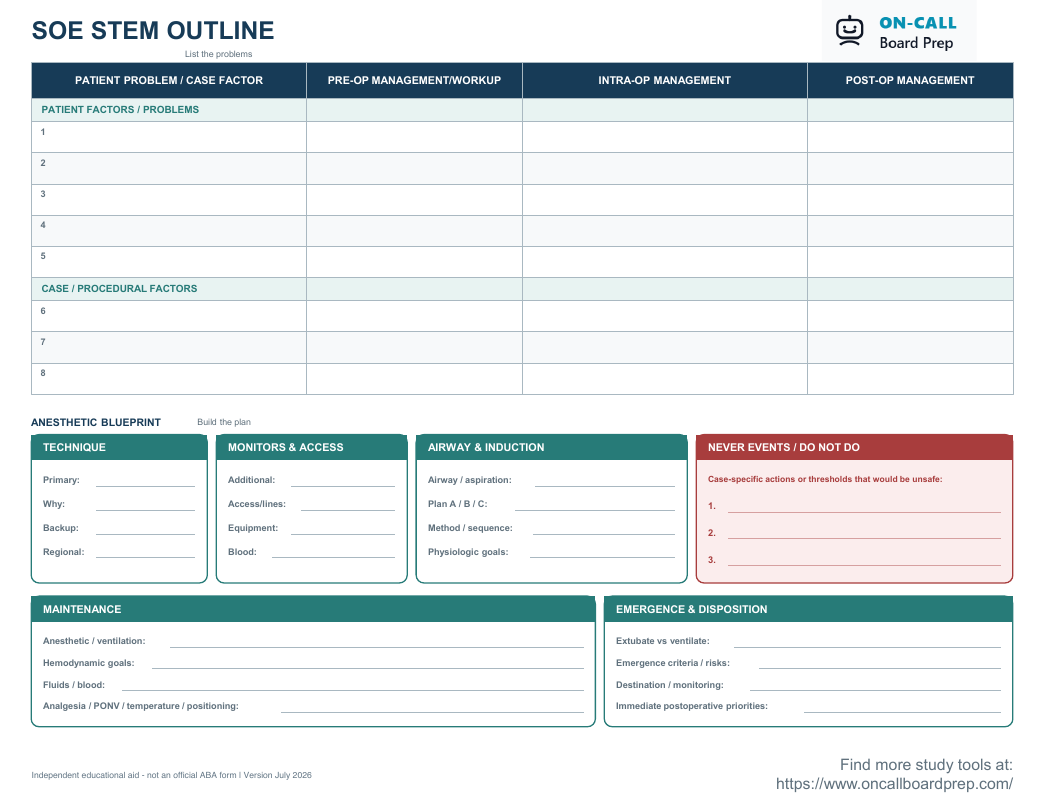
Download the printable worksheet PDF
The worksheet can be used to record:
- Ranked patient and procedural factors.
- Preoperative, intraoperative, and postoperative implications.
- Primary technique and rationale.
- Conditional backups.
- Airway and induction planning.
- Monitoring, access, equipment, and blood preparation.
- Physiologic goals.
- Case-specific unsafe actions or thresholds.
- Maintenance, emergence, and disposition.
It is optional. The method can be practiced on blank paper using four headings:
- Situation.
- Ranked priorities.
- Primary plan and contingency.
- First spoken answer.
Independence statement: This worksheet is an independent educational aid for practice. It is not an ABA form, scoring instrument, required answer structure, universal clinical template, or exam-day handout. The ABA has not endorsed this worksheet or the instructional method described here.
Sources and evidence boundaries
Official examination sources
- ABA APPLIED Exam manual: Source for the stated SOE duration, two 35-minute examination sessions, 20-minute and 10-minute Presented Stem reviews, and the publicly described emphasis on judgment, adaptability, organization, presentation, and scientific rationale. These descriptions should not be converted into an invented scoring rubric.
- ABA sample SOE questions: Source for visible question forms involving decisions, rationales, interpretations, alternatives, and changed information. The sample is not a complete blueprint, prediction, or model answer.
- Current ABA APPLIED Exam resources: Candidates should consult this official page for current rules and logistics.
- ABA mock SOE faculty-development workshop: Professional-education context for structured mock practice. It is not an official Candidate scoring rubric.
Learning and practice sources
- Systematic review of distributed and retrieval practice in health-professions education: Supports distributed and retrieval practice as learning methods. The included studies were heterogeneous, and the review does not establish an ABA SOE pass benefit.
- Test-enhanced learning in medical education: Supports effortful recall, spacing, and corrective feedback for retention. Application to spoken SOE responses is an educational extrapolation.
- Rapid-cycle deliberate-practice scoping review: Supports repeated performance with directed feedback for immediate performance improvement. Long-term transfer and superiority remain uncertain.
- Cognitive load theory in medical education: Supports managing working-memory demands while developing useful knowledge structures. It does not show that all cognitive load is harmful or validate this worksheet.
- Systematic review of self-regulated learning in clinical contexts: Supports a goal, practice, observe, and adjust cycle. It does not establish that self-assessment alone is accurate.
Boundaries of this resource
No cited study directly tests this worksheet or proves that this method improves ABA SOE outcomes. “Decision, reason, condition, stop” and the proposed minute allocations are optional practical heuristics, not official instructions.
This resource does not provide patient-specific clinical guidance or replace current evidence, local policy, supervision, or professional judgment. It does not supply drug doses or prescriptive clinical algorithms. The fictional example should receive named anesthesiologist review before publication.
Last reviewed: July 16, 2026.